
Europe Expansion
Vector Agents Enters Europe. Announcing Our Regional Leadership.

Europe Expansion
Vector Agents Enters Europe. Announcing Our Regional Leadership.



Not every sales team needs an enterprise-grade execution platform. Outreach.io is purpose-built for large teams with dedicated sales operations support.
For teams that don't fit that profile, it often creates more overhead than it removes.
This guide covers the main Outreach alternatives worth evaluating. It maps each one to the team profile it actually fits and includes a category most comparisons skip: autonomous AI SDR agents.
Rather than replicating the sequencing-tool model, these agents replace it entirely.
Outreach.io manages the engagement layer of the outbound process: multi-step sequences across email, calls, and LinkedIn; deal tracking; conversation intelligence; pipeline visibility; and revenue forecasting. It serves over 6,000 businesses globally.
Its strengths are consistent: deep Salesforce integration, advanced sequencing controls, and coaching analytics that connect individual rep activity to pipeline outcomes. Its limitations are equally consistent across user reviews. Pricing requires a custom quote and runs at enterprise cost.
HubSpot integration quality is weak relative to its Salesforce parity. And the platform's depth creates operational overhead that teams without dedicated sales ops absorb poorly; the process of configuring and managing Outreach competes directly with selling time.
The honest baseline: Outreach fits teams of 25 or more reps running Salesforce with a sales operations function in place. Below that threshold, the capability exceeds what the team can operationalise, and the cost reflects features the team won't use. If that description applies to your team, the Outreach.io alternatives below are worth a serious look.
The tools below are not all the same kind of product. Some are sequencing platforms. One is a contact database with sequencing bolted on. One is a digital worker that runs the SDR function autonomously. Matching the right option to the right team profile is the point of this comparison.
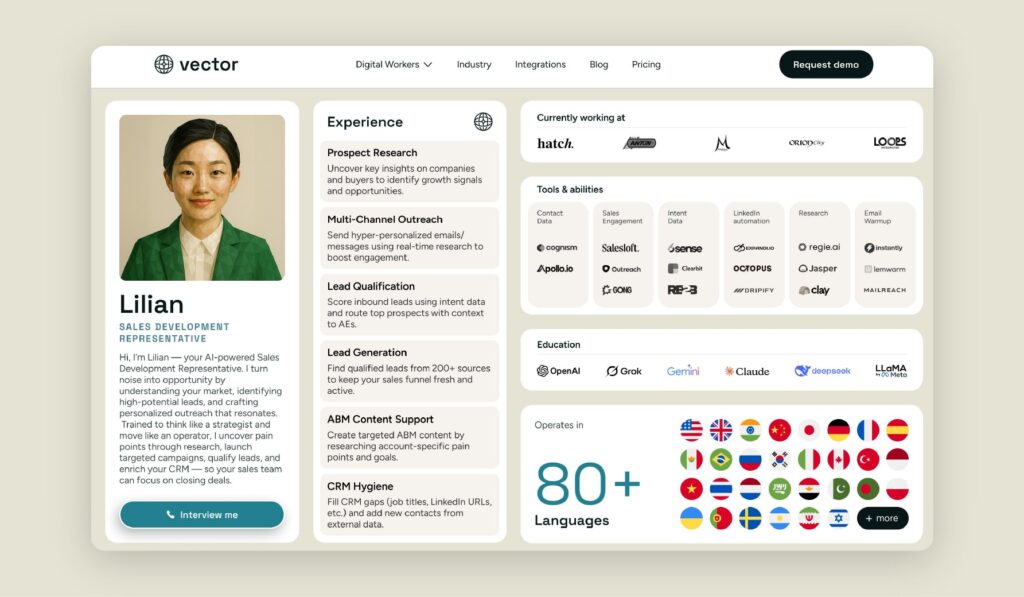
Best for: Teams where the SDR headcount cost is the constraint, not the sequencing tool.
Every alternative listed above shares one structural characteristic: a human SDR still owns the research, targeting, and personalisation. The tool manages the cadence. The SDR decides who goes in, builds the messaging, and adjusts based on results. Switching sequencing platforms changes the tool; it doesn't change the model. Sales reps spend 70% of their time on non-selling tasks, including research and meeting preparation, and that overhead follows the SDR role regardless of which sequencing tool sits underneath it.
Lilian is Vector Agents' AI Sales Development Representative. She is a digital worker, not a sequencing tool that an SDR operates. Prospect research, personalised outreach, lead qualification, and CRM enrichment all run autonomously. The SDR function runs without a human driving it; the sales team picks up at the conversation stage.
What that changes operationally:
Across the industry, 84% of sales reps missed quota last year, with pipeline generation upstream of the sequencing layer identified as the primary bottleneck. A tool change addresses workflow efficiency. Lilian addresses the pipeline generation problem at its source.
Pricing: Flat monthly subscription.
Key limitation: Native CRM integration is in development; data currently syncs via middleware.
Best for: Enterprise teams with Salesforce and a hard requirement for conversation intelligence.
Salesloft is the closest functional equivalent to Outreach. It combines cadence management, conversation intelligence, coaching analytics, and pipeline visibility in one platform. For teams whose requirements are structured multi-channel sequences, rep coaching tied to call data, and Salesforce-native pipeline visibility, Salesloft covers the same ground as Outreach.
The complication: Salesloft merged with Clari in 2025. G2 and Capterra reviews from 2025 and 2026 consistently flag reduced customer success access, slower support response times, and product roadmap uncertainty as the two platforms work toward integration. Teams evaluating Salesloft now should factor in whether that support degradation has stabilised before committing to an annual contract.
Pricing: Not publicly listed. Request a quote directly and factor in per-user scaling costs for larger teams.
Key limitation: No built-in contact database; teams need a separate data provider. Post-merger support track record is a real risk to evaluate before signing.

Best for: Outbound-heavy SDR teams that need prospect data and basic sequencing in one tool.
Apollo.io is the most commonly cited lower-cost outreach alternative. It merges a large B2B contact database with sequencing functionality, removing the need for a separate data provider. For teams currently managing ZoomInfo or a similar data tool alongside an engagement platform, Apollo consolidates that overhead into one subscription.
Its sequencing is functional rather than deep. It lacks the coaching analytics, deal forecasting, and conversation intelligence that justify Outreach's price point for larger teams. The more substantive concern is data quality: business email addresses tied to a role deactivate when the holder leaves, and in a database sourced from third parties, those records remain until a hygiene cycle removes them. Bounce rates accumulate between cleanings and compound sending domain reputation damage with each send, affecting deliverability on every subsequent campaign from that domain. Teams running high-volume outbound from Apollo without active list hygiene processes in place will eventually hit this ceiling.
Pricing: Transparent, tiered. Free plan available; paid plans start at $49 per user per month.
Key limitation: Data decay is a real operating cost that doesn't appear in the subscription price. Build list hygiene into the workflow budget before committing.

Best for: SMB and mid-market teams that need multichannel outreach with fast onboarding and transparent pricing.
Reply.io covers email, LinkedIn, SMS, and WhatsApp outreach in a single platform, with a built-in B2B database and AI-assisted sequence writing. Onboarding is faster than enterprise platforms, pricing is publicly listed, and the multichannel coverage suits teams that want personalised outreach across channels without managing separate tools for each.
The limitations are worth naming. LinkedIn integration reliability is a recurring complaint in user reviews, with the extension flagged as buggy across multiple review periods. CRM integrations outside Salesforce are rated inconsistently. For teams whose outbound motion depends heavily on LinkedIn sequencing, Reply.io's track record here warrants testing before a full deployment.
Pricing: Transparent, tiered. Starts at $59 per user per month for email-only; multichannel plans higher.
Key limitation: LinkedIn integration reliability issues. CRM integration quality varies by platform.
Best for: Call-heavy inside sales teams that want transparent pricing and multi-channel cadences without enterprise complexity.
Klenty is built for inside sales teams running a call-first or call-heavy outbound motion. It covers email, calls, LinkedIn, and SMS in one workflow, includes parallel and power dialers in growth plans without charging extra for them, and publishes all pricing upfront. CRM integrations with Salesforce, HubSpot, Pipedrive, and Zoho are consistently rated above average in user reviews, and a built-in deliverability suite covers warmup, validation, and placement testing.
What it doesn't include: a contact database. Teams using Klenty need a separate data provider for prospecting, which adds a tool to manage and a cost to the stack. For teams already running a data tool they're satisfied with, that's not a blocker. For teams looking to consolidate everything into one platform, Apollo is worth comparing directly.
Pricing: Transparent, tiered. Starts at $50 per user per month.
Key limitation: No built-in contact database. Teams need a separate prospecting tool alongside it.
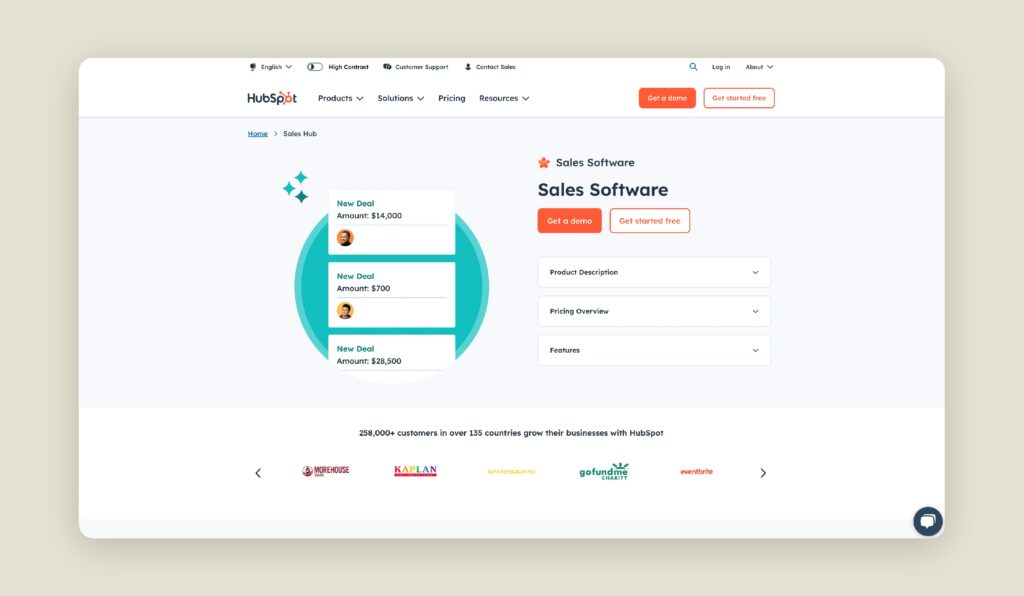
Best for: Teams already running HubSpot as their CRM that want sequences without a second platform.
HubSpot Sales Hub builds sequences directly into the CRM rather than running a separate engagement platform alongside it. For teams with HubSpot already in place, this removes integration overhead, data sync complexity, and the additional licence cost of a standalone sequencing tool. Setup is fast, and CRM data stays in one place.
The trade-off is sequencing depth. HubSpot Sales Hub handles moderate outbound volume well. It doesn't match the sequence complexity, reporting granularity, or coaching capabilities of dedicated engagement platforms at scale. For teams growing past 25 reps with increasing outbound volume, the ceiling becomes visible faster than with a dedicated platform.
Pricing: Tiered by contact volume and feature set. Starts at $20 per seat per month for basic features; full sales engagement tools require higher tiers.
Key limitation: Limited sequencing depth at scale. Not the right primary engagement platform for large, structured sales organisations.
The question worth asking before committing to a tool switch is whether the problem is the sequencing platform or the model it depends on.
Teams that move from Outreach to a mid-market sequencing tool change the cadence manager but not the underlying structure: an SDR still owns the research, targeting, and messaging quality, so the hours spent on non-selling tasks follow the role, not the tool. Pipeline targets don't shift when the sequencing layer gets cheaper; they shift when the top-of-funnel volume or quality changes. Moving from Outreach to Apollo or Klenty reduces the tool cost. It doesn't change how many hours an SDR spends on research before a single email goes out.
This is why the right answer for some teams is a model change rather than a tool swap. The outbound function currently assumes a human in the loop at every stage of prospecting. When the headcount cost of that assumption is the real constraint, replacing Outreach with a cheaper sequencing tool moves the budget line without moving the pipeline number.

Most decisions in this comparison come down to team size, CRM, and whether the sequencing layer or the SDR model is the problem being solved.
Most teams evaluating outreach competitors start by comparing sequencing platforms. That's the right starting point if the current tool genuinely doesn't fit the team's size, CRM, or motion. The six outreach.io alternatives above cover most tool-level decisions cleanly.
The more consequential question is whether the outbound model needs to change. Every sequencing tool in this list assumes an SDR in the loop. When that headcount is the cost that can't scale, or the pipeline target requires top-of-funnel volume the team can't generate manually, the tool comparison is the wrong conversation. The right move removes the human dependency from prospecting, research, and initial outreach entirely.
If your pipeline bottleneck sits upstream of the sequencing layer, book a demo to see how Lilian handles the prospecting, research, and outreach your SDR team is currently running manually.
For teams under 25 reps without dedicated sales ops, Apollo.io and Klenty are the most practical options. Apollo combines a contact database with sequencing in one tool. Klenty offers transparent pricing, multi-channel cadences with a built-in dialer, and reliable CRM integrations across Salesforce, HubSpot, Pipedrive, and Zoho, without enterprise-level complexity.
Salesloft is the closest functional equivalent, offering cadence management, conversation intelligence, and pipeline visibility in one platform. Following its 2025 merger with Clari, user reviews consistently flag reduced customer success access and product roadmap uncertainty. Teams with Salesforce and a hard requirement for conversation intelligence will still find it the most comparable substitute.
Sequencing tools manage outreach cadences; an SDR still handles the research, targeting, and personalisation. An AI SDR agent like Lilian runs those functions autonomously: prospecting, outreach, qualification, and CRM enrichment operate without a human in the SDR role. The sequencing tool and the SDR headcount it supports both come out of the cost model.
Most mid-market alternatives, including Apollo.io, Klenty, and Reply.io, offer HubSpot integrations. Klenty's HubSpot sync is consistently rated higher than Reply.io's in user reviews. HubSpot Sales Hub is the most native option, with sequences built directly into the CRM rather than running through a separate platform.
The tool subscription is one input. Factor in migration time, data export and re-import overhead, SDR retraining on a new platform, and CRM re-mapping. For teams evaluating autonomous agents, the relevant comparison is the full cost of the current model: tool licence, SDR salary, benefits, ramp time, and management overhead combined, not tool vs. tool.

.svg)


.svg)
Vector AI All rights reserved. © 2025


.jpeg)