
Europe Expansion
Vector Agents Enters Europe. Announcing Our Regional Leadership.

Europe Expansion
Vector Agents Enters Europe. Announcing Our Regional Leadership.


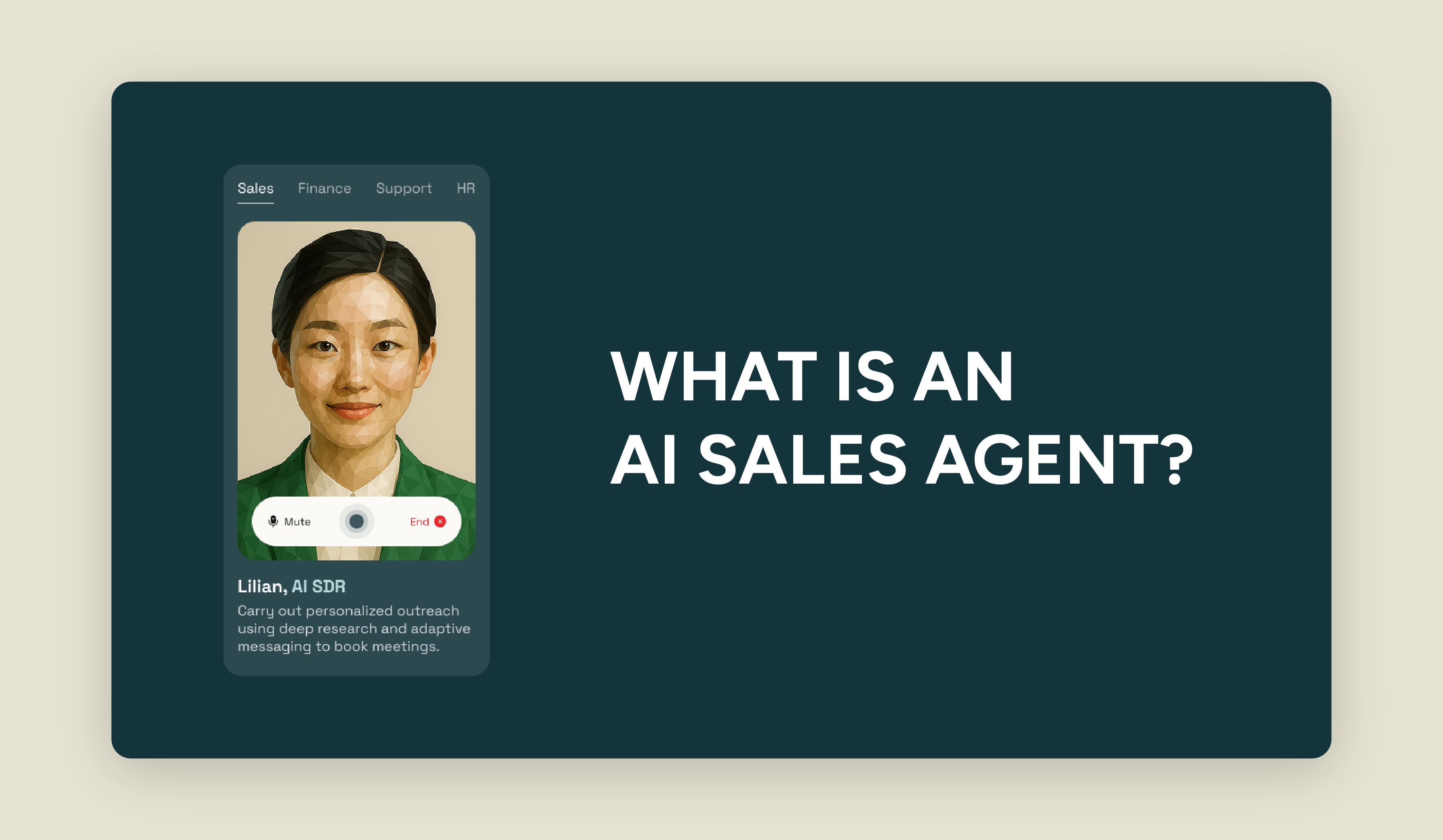
Outbound capacity can now be added without opening a requisition. That is the claim behind AI sales agents, and for any team whose pipeline target moved before its headcount did, it is the more consequential half of the capacity plan.
The complication is definitional. "Agent" now covers products that behave nothing alike. Some produce sales work on their own initiative. Others make a rep faster and stop there. Both get described the same way on a pricing page, and only one of them competes with a hire.
This guide covers what these systems are, which parts of the SDR job they take over, where they fail, and how to judge whether one belongs in your next capacity plan.

Most sales teams already run software that sends email without anyone clicking send. That is not the change.
An AI sales agent is software that performs sales work on its own initiative, deciding what to do next and completing a chain of steps without a person approving each one. The difference from what you already own is the initiation pattern, not the model underneath.
In practice an agent pulls context from CRM records and email threads, plans across several steps, executes across connected systems, and adjusts on what comes back. The chat tools of the previous generation could hold a conversation but not act on it.
Slightly more than half of sales teams run agents today, with another third expecting to inside two years. What is not settled is which problem teams point them at.
The buying question gets easier once you know where the hours actually go.
Sales reps spend 40% of an average workweek selling. The rest goes to prospect research, list building, manual CRM entry, and planning. That split, not headcount, caps pipeline generation.
The two standard responses leave it intact. Hiring adds capacity, but only after a ramp period during which the new SDR absorbs management time and produces little. Another tool gives the same person another interface to maintain, which moves work sideways rather than off the team.
There is a second effect, and it shows up in territory coverage rather than in activity metrics. When research time is scarce, reps work the accounts they already recognise, because those need the least preparation. The rest of the target list goes untouched, so activity reporting stays healthy while whole segments of the territory are never contacted. A two- or three-person SDR team is not choosing to skip those accounts. It does not have the hours to reach them.
That is the constraint agents get sold against. Whether one relieves it depends on which kind you buy.
Two products can both be called agents and land completely differently on a capacity plan.
An AI sales assistant measured against a headcount decision will always look expensive, because it is not producing the output that headcount was going to produce. Deployments often sit between the two poles, because approval gates are set at defined stages and removed as confidence builds.
The fastest test is to ask what the product produces if nobody opens it for a week. A sales AI assistant with no output of its own cannot absorb work a person is currently doing. Once you know you are looking at the autonomous end, the next question is which tasks move.
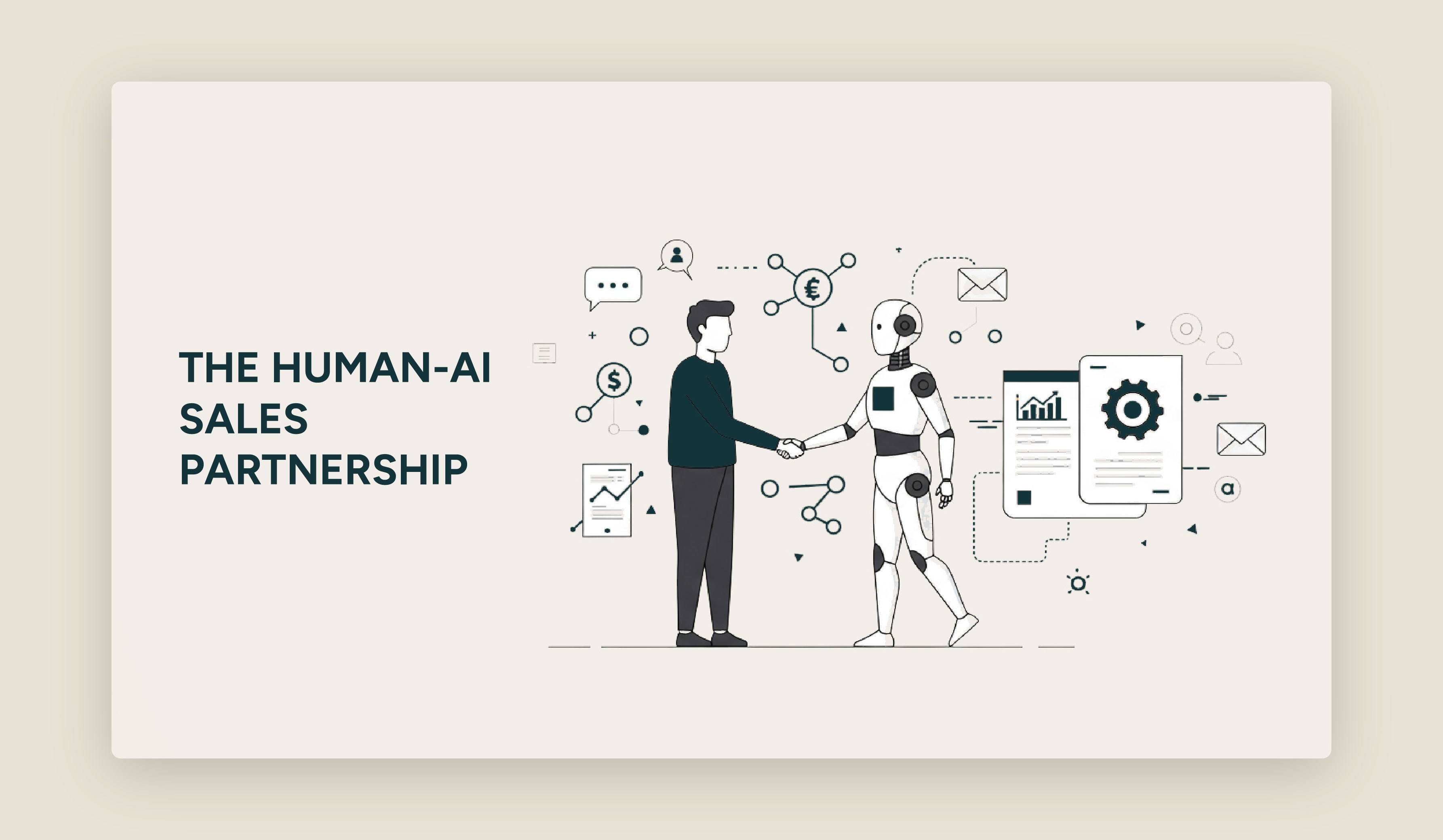
Scope is where evaluations go wrong, because the marketing describes the whole funnel while the working product covers a slice of it.
None of this is new work. It is existing work run at a volume human capacity does not allow, which is why SDR agents show up in prospecting long before later-stage selling. High performers are 1.7 times more likely than underperformers to use agents for prospecting.
An open SDR requisition is usually when a Head of Sales asks this seriously, because the requisition is already an admission that pipeline generation is short. That is the ceiling of what AI sales agents cover today. The floor matters just as much.
Almost every failure here traces back to the same place, and it is not the model.
The data quality failure deserves spelling out, because in outbound the damage compounds rather than accumulating. Sending to decayed contact data generates bounces and spam complaints. Those signals lower the sending domain's reputation with mailbox providers, which suppresses inbox placement for everything sent from that domain afterwards, including the correctly targeted messages.
The cost of a badly aimed agent is not limited to the wasted sends. It is charged against the next quarter of outbound as well.
Readiness for AI sales agents is a data and workflow question before it is a vendor question.
Deployment and value are not the same event. By 2028, agents are expected to outnumber human sellers by ten to one, while fewer than 40% of sellers will say agents improved their productivity. That difference is the data work teams skip.
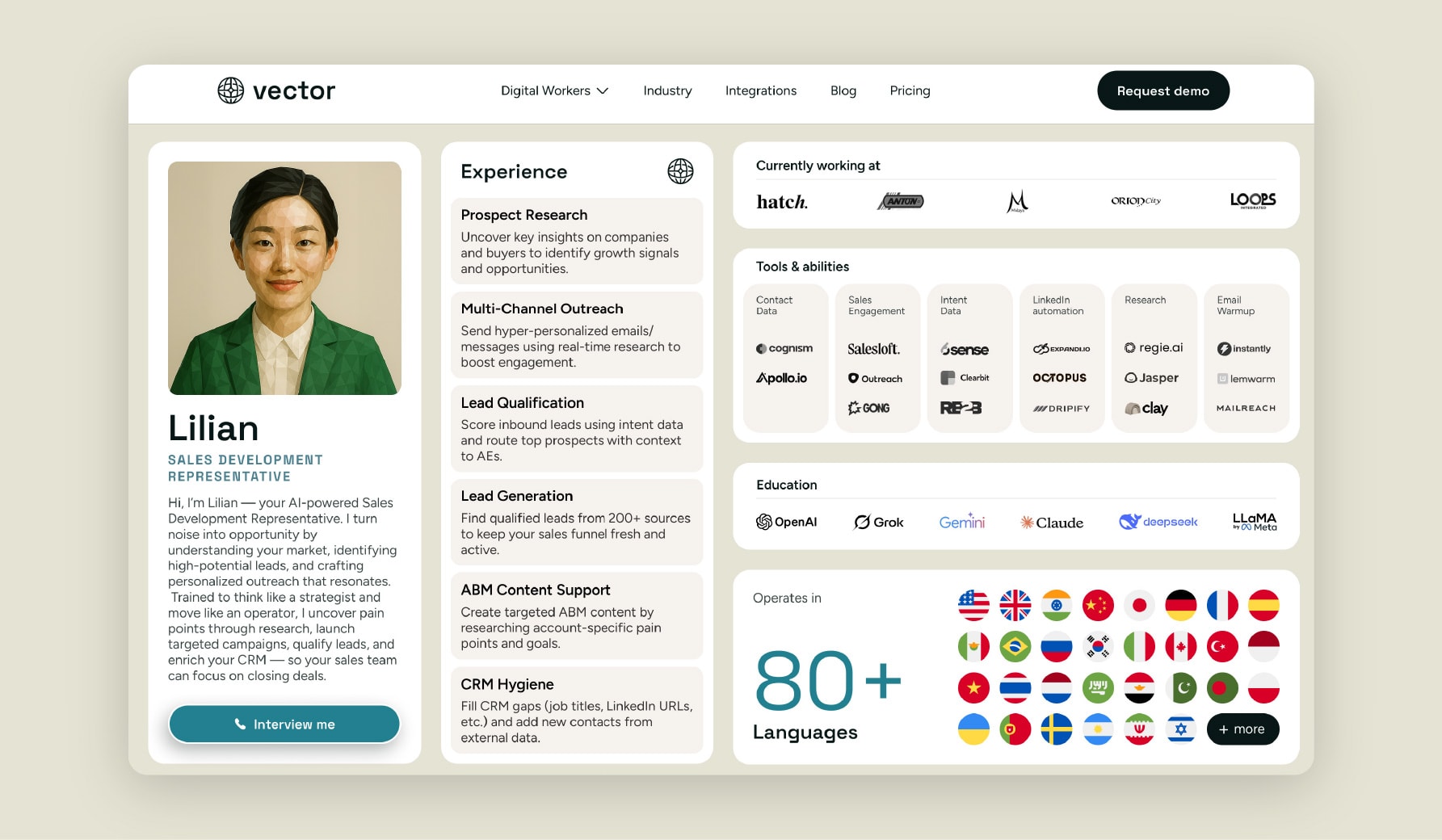
The capacity problem this article started with is a research and first-touch problem before it is a headcount problem. That is the work Lilian does.
Lilian is an AI digital worker from Vector Agents who handles outbound prospecting end to end. She researches accounts across more than 200 sources, builds and enriches the target list, writes first-touch outreach against what she found rather than a template, scores inbound leads, and passes qualified prospects to an Account Executive with the context attached.
The output is territory coverage that does not depend on who has time: accounts at the bottom of the list get researched and worked instead of ignored, and the pipeline that comes from them arrives without an added requisition.
Her approach to outbound is precision rather than volume, which protects the sending domain. Fewer, better-targeted messages generate fewer bounces and complaints, so inbox placement holds for the sends that matter.
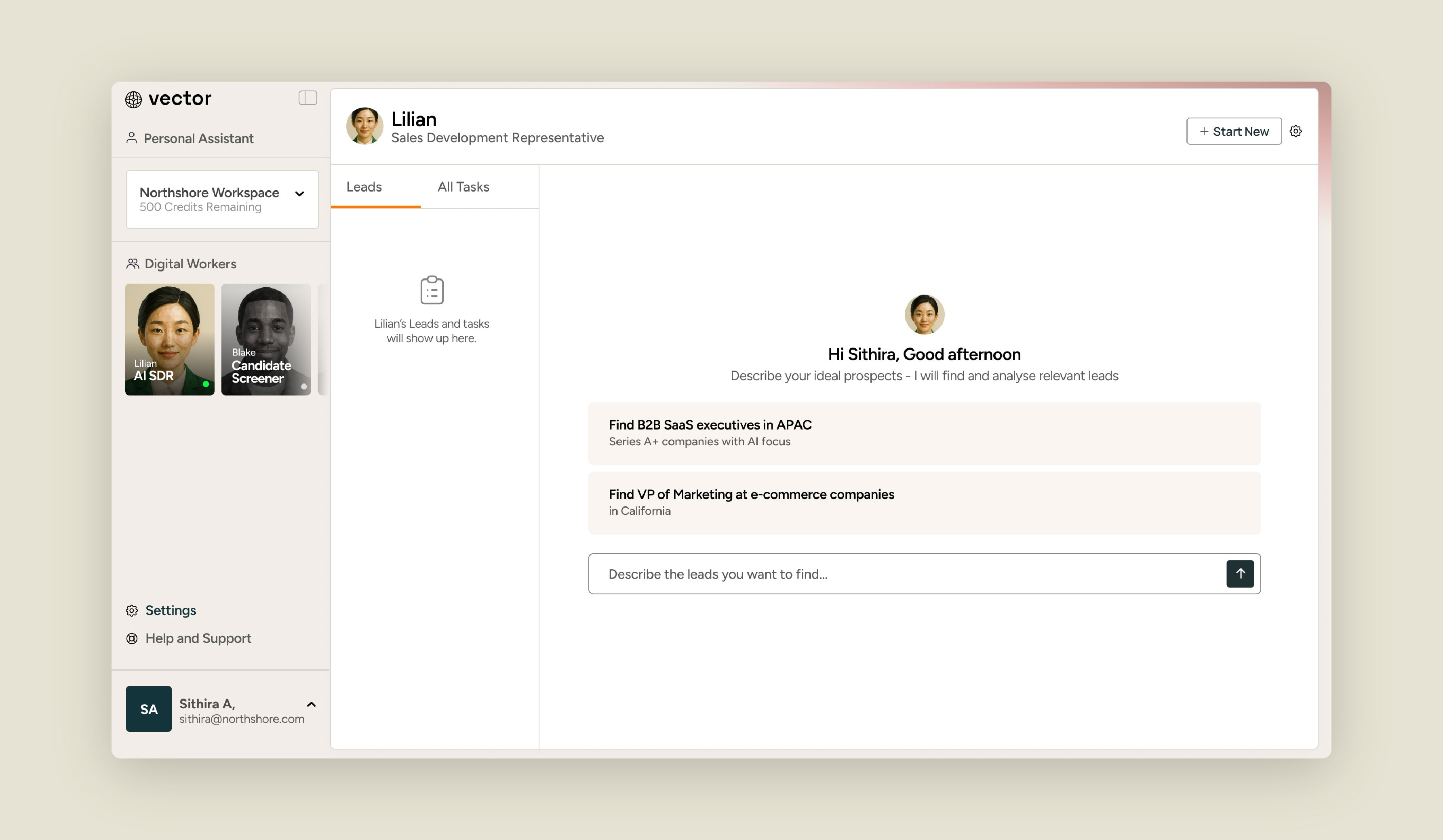
The decision in front of most sales leaders is not whether AI sales agents are real. It is where the next unit of outbound capacity comes from, and whether an agent or a requisition supplies it.
One distinction carries the answer. Assistive products make a rep faster and leave the headcount plan where it was. Autonomous ones produce work a person would otherwise have produced. Beyond that, the outcome depends on data quality and workflow choice more than on vendor choice.
If research and first-touch work is consuming the hours your team should be spending in conversations, book a demo with Vector Agents and see what the pipeline looks like when Lilian is the one generating it.
Deployment time depends on data access and guardrail definition, not the agent itself. A single narrow workflow, such as inbound lead response, moves fastest because the configuration is limited to one set of rules. Full-funnel deployments take longer, since every workflow needs its own logic, escalation rules, and testing.
An agent needs a reliable record of accounts, contacts, and interaction history, which for most teams means the CRM. Without it, the agent can still send outreach, but it cannot avoid duplicate contact, apply consistent qualification, or hand a rep the context behind a booked meeting.
A chatbot responds inside a conversation and stops when it ends. An agent acts across systems and completes tasks: researching an account, updating a record, sending outreach, booking a meeting. The distinction is execution rather than conversational quality, which is why a chatbot cannot absorb SDR workload.
Yes. Disclosure is standard practice in B2B outbound, and several jurisdictions now regulate it. A prospect who discovers the deception later attributes it to the company rather than the software, which puts the account relationship at risk rather than the tooling decision. Name the agent and route to a human on request.
Ownership splits cleanly. Sales defines the goal, qualification criteria, and escalation rules, because those are commercial decisions. RevOps owns data quality, system integration, and monitoring, because output quality is a function of the data underneath. Splitting it any other way stalls the deployment.

.svg)


.svg)
Vector AI All rights reserved. © 2025


.jpeg)